
New US sanctions against Rwanda’s defence ministry and a military-linked financial institution have brought renewed attention to the conflict in eastern Democratic Republic of Congo (DRC), the trade in conflict minerals and the financial networks that may support it. For businesses operating in or trading with Rwanda, the measures also raise important questions about exposure to sanctions, supply-chain relationships and the need for enhanced due diligence.
On 28 October 2026, the US announced sanctions on Rwanda’s Ministry of Defence and Zigama Credit and Savings Society, a financial institution serving Rwanda’s security services, which the US has accused of supporting armed activity in the mineral-rich eastern region of the DRC.
The US says the measures respond to an alleged violation of the US-brokered peace process between Rwanda and the DRC, culminating in the December 2025 accord also known as the ‘Washington Accords’, which were intended to end the decades-long conflict between both countries.
Conflict Minerals Trade in Rwanda
The conflict between the two countries — which have overlapping borderlands — has been marked by alleged infiltration of the DRC by Rwanda, although Rwanda has repeatedly denied this activity.
Amnesty International has alleged that Rwandan military forces, through their operations in eastern DRC, smuggle minerals including gold and coltan to Rwanda. This creates a distribution network involving Rwandan businesses such as Gasabo Gold Refinery, before the minerals are distributed internationally. Gasabo Gold Refinery, along with its top executives, were sanctioned by the EU in 2025 and by the US Department of the Treasury in June 2026.
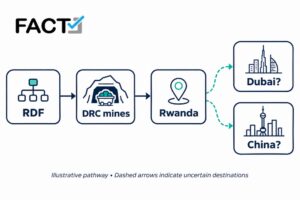
Conflict trade in Africa has been prevalent for decades, with significant gold trade statistics pointing to possible smuggling and trade-based laundering in the regional gold market. A 2020 report by The Sentry highlighted a discrepancy between Rwanda’s declared gold output of 0.03 – 0.36 tons and UAE gold imports from Rwanda recorded at 18.1 tons worth USD 637 million.
The Rwandan Position
While the statistics reflect the plausibility of these allegations, Rwandan authorities have consistently denied them and claimed that the international community does not understand the context. This conflict dates to the 1994 genocide in Rwanda, which Paul Kagame, Rwanda’s current President of 26 years, played a role in ending, later becoming a leader in Rwanda’s government. Since then, the Rwandan military (Rwanda Defence Force, RDF) has allegedly undertaken military action in the DRC, claiming to be targeting key participants in the 1994 genocide. The RDF has also been accused of funding M23, a designated rebel group allegedly pursuing similar aims.
Economic and Financial Implications
The October 2026 sanctions also targeted Zigama Credit and Savings Society, a member-owned financial cooperative bank serving members of Rwanda’s military and law enforcement. This bank has been identified by the US Treasury as facilitating arms financing and the provision of logistical support for smuggled minerals. With a reported profit of about USD 26 million in 2025, the sanctions could affect many of its members, particularly in cross-border transactions.
While other financial institutions in Rwanda were not named in the sanctions, it is possible that they did not come as a surprise, as recent developments in Rwanda’s banking industry show a preferred alignment with China for cross-border transactions, which could be seen as part of a de-dollarisation strategy, aimed at reducing reliance on the US dollar for international payments and trade.
In September 2026, the Bank of Kigali announced its connection to China’s cross-border payment network known as CIPS (Cross-border Interbank Payment System), stating that it is the first institution in East and Central Africa to do so. The announcement drew reactions on social media, with several posts from Rwandans praising this move and describing counter-proliferation financing as bullying.
Rwanda’s Evolving Due Diligence Landscape
These developments have important implications for due diligence in Rwanda, particularly as the country’s geopolitical and financial relationships evolve.
With the country emerging as a business hub for Africa, the risk landscape could change soon, and this affects sectors such as agriculture, mining, luxury goods and banking.
The immediate concern extends beyond the entities named in the sanctions. Businesses need to understand whether their counterparties, ownership structures or supply chains create indirect exposure. That makes enhanced due diligence, including asset and title tracing, offshore-structure and supply-chain mapping, and financial forensics, increasingly important. In Rwanda’s changing investment climate, understanding these connections is a practical matter of risk management and corporate governance.
Share This Story, Choose Your Platform!
Rwanda’s Conflict Minerals Trade: What New US Sanctions Mean for Businesses
Read More →New US sanctions against Rwanda’s defence ministry and a military-linked financial institution have brought renewed attention to the conflict in eastern Democratic Republic of Congo (DRC), the trade in conflict [...]
Contact FACT
Get in touch with our team.
Whether you have a specific requirement or want to understand how we can help, our specialists are ready to talk. All enquiries are handled in confidence.